
Welcome to navigating your PROS journey
This page has been created with you in mind:
Whether you are the person living with PROS (PIK3CA Related Overgrowth Spectrum)
Or a parent of someone living with PROS
or a young person who is growing up with PROS.
Please note that any of the worksheets you find on the following pages can be sent directly to you. Please email us your details at Our email address
Our resources:
These resources have been developed in collaboration with researchers at the Centre for Appearance Research (UWE Bristol), the GoPI3Ks charity, and individuals with PROS. They contain explanations of PROS and how it can impact children, adults, and parents, information for healthcare professionals, and exercises and resources that can be used to help support people with PROS and their families.
At the end of this page you will find links to separate pages that are dedicated to the following: Children and young people with PROS, adults with PROS, parents and carers of children with PROS and navigating health professionals.
What is PROS?
PROS, which is also known as PIK3CA-Related Overgrowth Spectrum, is a term for a group of conditions that can impact growth in different areas of the body. These can include in vascular areas (such as blood vessels), skeletal areas (such as bone or limb differences), and skin differences. It can also impact other areas such as intellectual development and co-existing conditions like asymmetry in the face and macrodactyly. PROS is also a condition that can affect how someone looks, therefore, causing a visual difference in appearance. A visual difference is described as: “a distinct, noticeable physical feature on an individual’s body—such as a scar, mark, birthmark, or condition—that deviates from typical societal norms.”
What we did:
The study was an online anonymous survey that had a mix of multiple-choice and write-in questions. The questions asked about lots of different aspects of life (such as finances, relationships, education, and medical experiences) and aimed to get information about how PROS can impact a person’s life. A mix of parents of children with PROS and young people and adults with PROS took part in the survey. We used those results to put together some key findings and useful quotes that you will find throughout these resources. They have also helped us to guide how we made these resources and what topics we focused on.
Who took part:
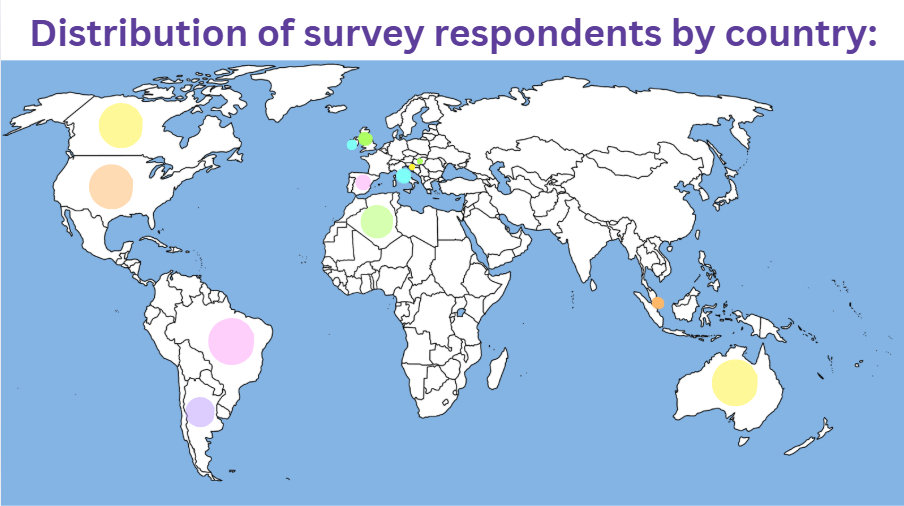
In total, 75 people took part. This included 41 parents of children with PROS, 32 adults with PROS and 2 young people with PROS. The map below shows how many different countries took part in the survey. Responses came from a total of 14 countries across North America, South America, Africa, Europe, Oceania, and Asia.
In adults and young people talking about themselves, we found that the most common diagnosis for PROS was Klippel Trenaunay Syndrome. Parents shared that the most common diagnosis given to their children was a general diagnosis of PROS.
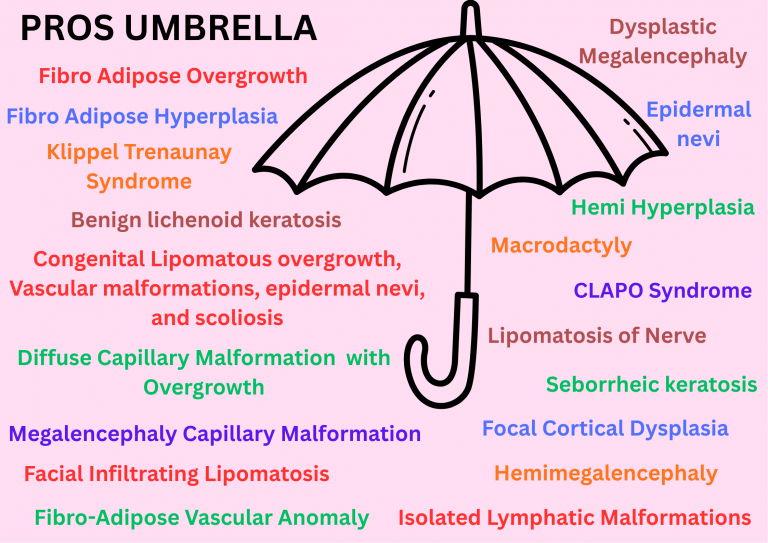
PROS can be a diagnosis in itself, but it can also be the umbrella term for a subtype of the condition:
CLOVES syndrome (Congenital Lipomatous Overgrowth, Vascular malformations, Epidermal naevi and Skeletal abnormalities)
- Congenital lipomatous overgrowth: Fatty masses are present at birth, typically on the trunk or buttocks. They may appear on one or both sides of the body.
- Vascular malformations: These may include red or purplish birthmarks, prominent veins, or problems with blood clots. Problems with blood vessels can lead to pain and inflammation in the affected areas, as well as bleeding in the skin, stomach, intestines, or bladder.
- Epidermal nevi: These are also known as moles.
- Scoliosis/skeletal/spinal abnormalities: Limb overgrowth (often uneven), wide hands or feet, large fingers or toes, and curving of the spine are common.
- For more information please see: CLOVES Syndrome
KTS (Klippel-Trenaunay Syndrome)
- A syndrome is a collection of symptoms that often appear together. The symptoms are characterized by three main features: Port-wine stains (skin discoloration), Varicose veins, Hypertrophy (excess growth) of one limb
- Klippel-Trenaunay syndrome is present at birth (congenital) but often the only visible sign in babies is the port wine stain. The diagnosis may not be confirmed until the varicose veins and limb hypertrophy become more noticeable.
- For more information please see: KTS
FAVA (Fibro-AdiposeVascularAnomaly)
- is a rare condition where the body’s own tissue infiltrates a muscle, forming a tumour-like mass, usually in one or more limbs.
- “We all have fatty tissue – called adipose tissue – in our bodies. Adipose tissue serves the important function of storing fat. And we all have muscles in our extremities – our arms, hands, legs, and feet. Our muscles are made up of collections of muscle cells called muscle fibers, along with blood vessels, tendons, and nerves. The current hypothesis among experts is that in a patient with a fibro- adipose vascular anomaly, there is a disproportionate increase in fat in one or more muscles, combined with fibrous scar tissue, which disorganizes the normal pattern of muscle fibers.”
- For more information please see: FAVA
HH (Hemi Hyperplasia)
- Hemihyperplasia, formerly called hemihypertrophy, is a rare disorder in which one side of the body grows more than the other due to an excess production of cells, causing asymmetry. In a normal cell, there is a mechanism that turns off growth once the cell reaches a certain size. However, in hemihyperplasia, the cells on one side aren’t able to stop growing. This causes the affected body area(s) to continue growing or enlarge abnormally. The disorder is congenital, which means that it is evident at birth.
- For more information please see: HH
FIL (Facial Infilitrating Lipomatosis)
- Facial infiltrating lipomatosis (FIL), also referred to as congenital infiltrating lipomatosis of the face or facial infused lipomatosis, is an ultra-rare craniofacial overgrowth condition caused by a genetic mutation of the PIK3CA gene. The condition is a part of the PIK3CA related overgrowth spectrum (PROS).[2] The disease is congenital and non-hereditary.
- For this disease the mutation causes overgrowth of half of the face (hemifacial). It affects both soft and hard tissue (facial skeleton). The condition is noticeable at birth by the asymmetrical cheeks, with one cheek being prominently larger than the other.
- For more information please see: FIL
MCAP/MCM (Megalencephaly-Capillary Malformation)
- Megalencephaly-capillary malformation syndrome (MCAP/MCM) is a condition characterised by overgrowth of several tissues in the body. Its primary features are a large brain (megalencephaly) and abnormalities of small blood vessels in the skin called capillaries (capillary malformations).
- Many people with this condition have a disproportionately large head and discoloration of the skin. Enlargement of the brain, known as megalencephaly, can lead to problems such as headaches, seizures, behavioral problems, and trouble breathing.
- For more information please see: M-CM/MCAP
DCMO (Diffuse Capillary Malformation with Overgrowth)
- Is a clinical condition characterized by multiple, widespread capillary malformations combined with tissue overgrowth and foot anomalies.
- For more information please see: DCMO
CLAPO syndrome
- CLAPO is a condition consisting of capillary malformation of the lower lip (C), lymphatic malformation of the face and neck (L), asymmetry of face and limbs (A) and (P)artial or generalized overgrowth
- For more information please see: CLAPO
Macrodactyly (abnormally large fingers or toes)
- Is a condition where fingers or toes are abnormally large due to overgrowth of bone and soft tissue. It occurs more frequently in the hands than in the feet. This is a congenital condotion, meaning it is present at birth.
- For more information please see: Macrodactyly
FAH (FibroAdipose Hyperplasia)
- Fibroadipose hyperplasia (FAH) sometimes also known as (FAO) FibroAdipose Overgrowth manifests as patchy overgrowth of a limb or part of the body.
- The overgrowth is due to fatty, fibrous and/or blood vessel overgrowth in a particular region of the body.
- This is usually not evident at birth and the overgrowth typically gets worse over time.
- For more information please see: FAH
FAO (FibroAdipose Overgrowth)
- Similar to FAH but typically refers to abnormal overgrowth of fibrous and fatty tissue that can affect limbs or other body parts
- FAO often overlaps with signs and symptoms associated with Macrodactyly, HHML, Muscular HH, and CLOVES syndrome
- For more information please see: FAO
LON (Lipomatosis of Nerve
- Is a condition where fatty tissue overgrows around nerve bundles, causing pain and numbness. It most commonly affects the median nerve and can lead to carpal tunnel syndrome
- For more information please see: LON
DMEG (Dysplastic Megalencephaly)
A congenital brain malformation where one or both cerebral hemispheres are abnormally large and malformed. It is often used interchangeably with hemimegalencephaly (HME), especially when the overgrowth is one-sided.
Brain overgrowth and malformation: The brain’s hemispheres are enlarged and have a dysplastic, or malformed, structure.
Developmental delays: Affected individuals typically experience early and significant developmental delays.
Intractable epilepsy: Severe seizures often begin in the first few months of life and can be difficult to control with medication.
Intellectual disability: A high degree of intellectual disability is common.
Physical signs: A disproportionately large head is common, and other symptoms can include body asymmetry and defects in muscle tone.
- For more information please see: DMEG
ILM (Isolated Lymphatic Malformations)
- are rare, non-cancerous masses formed by fluid-filled spaces due to abnormal lymphatic system development.
- They can occur anywhere in the body except the brain, most often in the head and neck.
- These masses are typically soft, spongy, non-tender, and vary in size depending on their location
- For more information please see: ILM
PIK3CA – related nonvascular lesions:
Epidermal nevi
- An epidermal nevus (plural: nevi) is an abnormal, noncancerous (benign) patch of skin caused by an overgrowth of cells in the outermost layer of skin (epidermis).
- Epidermal nevi are typically seen at birth or develop in early childhood.
- For more information please see: Epidermal nevi
Seborrheic keratosis
- These are usually brown, black or light tan. The growths look waxy, scaly and slightly raised. They usually appear on the head, neck, chest or back.
- Seborrheic keratoses are harmless and not contagious.
- They don’t need treatment, but you may decide to have them removed if they become irritated by clothing or you don’t like how they look.
- It is a common noncancerous skin growth and people tend to get more of them as they get older.
- For more information please see: Seborrheic keratosis
Benign lichenoid keratosis
- Lichenoid keratosis (LK) is a common benign skin growth that typically presents as an evolving single discrete papule on the trunk or upper extremities of adults.
- LK occurs almost always as a solitary skin growth; however, two or three lesions can occasionally be present.
- Approximately 8% of patients with LK will have two discrete lesions, 1% with three; more than three lesions are exceedingly rare.
- For more information please see: Benign lichenoid keratosis
- Focal Cortical Dysplasia (FCD) is a developmental brain malformation where part of the cerebral cortex forms abnormally during foetal development. This leads to disorganized cortical layers and abnormal neurons, disrupting normal electrical signalling. FCD is one of the most common causes of drug-resistant epilepsy. Please note – there is conflicting evidence linking the PIK3CA gene to FCD, so there is not a fully-evidenced backed link between the two: FCD
Findings from the survey:
The findings from the survey have been used to inform the creation of these resources. Some key points that we found from the answers included:
The lack of multidisciplinary care and informed healthcare professionals treating people with PROS.
The significant financial impact of the condition (due to travel, specialist equipment and clothing/shoes, medical bills).
The impact on mental wellbeing of people with PROS and parents of children with PROS – the anxiety of facing bullying, uncertainty of the condition and the future, the mental burden of dealing with pain and constant medical care.
The significant impact on working life for adults with PROS and parents of children with PROS – time off for appointments and symptoms, needing part time or flexible work, and having to use holiday days for their PROS rather than holidays themselves.
For more information on navigating the journey whether you are an adult with PROS, a child or young person or a parent, please see links below: